$38.99Original price was: $38.99.$34.99Current price is: $34.99.
In stockShips today if ordered by 3 PM ESTUSA fulfillment
Research Studies
✓Studied as a synthetic tuftsin analog in anxiolytic and cognition research.
✓Investigated for effects on GABAergic and neuroimmune signaling in vitro.
✓Used in laboratory models of stress-response and neuroplasticity.
✓Applied in behavioral research assays.
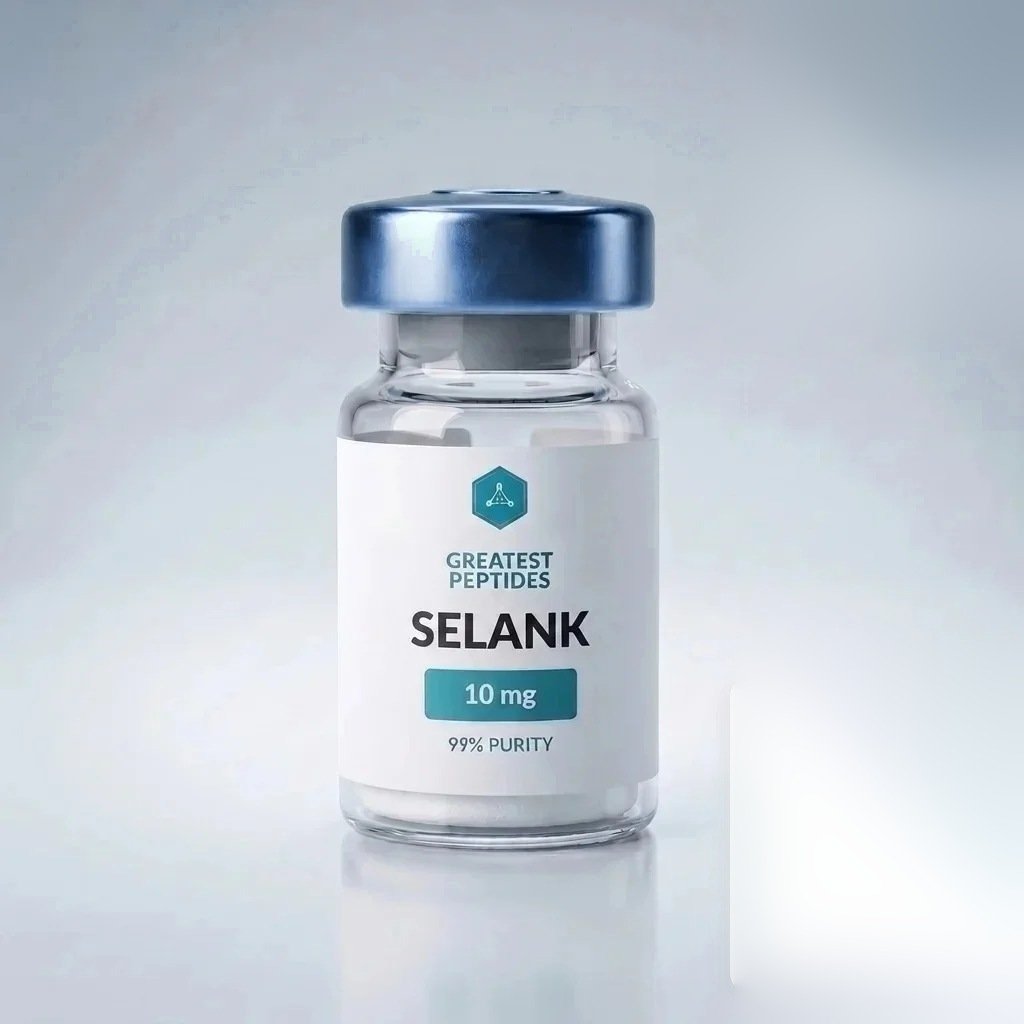
Selank 10 mg is supplied at 99%+ purity for in-vitro laboratory research only. Not for human or veterinary use.
Also searched as: Selank peptide.
Reconstituting this vial? Our free peptide reconstitution calculator converts vial mass and diluent volume into concentration, draw volume and U-100 syringe graduations. Research use only.
ALL ARTICLES AND PRODUCT INFORMATION PROVIDED ON THIS WEBSITE ARE FOR INFORMATIONAL AND EDUCATIONAL PURPOSES ONLY. The products offered on this website are intended solely for research and laboratory use. These products are not intended for human or animal consumption. They are not medicines or drugs and have not been evaluated or approved by the FDA to diagnose, treat, cure, or prevent any disease or medical condition. Any form of bodily introduction is strictly prohibited by law.
Selank is a synthetic heptapeptide analog of the naturally occurring immunomodulatory peptide tuftsin, developed for neuroscience research. It is widely used as a tool compound in anxiety, cognition, and neuroimmune signaling models. Greatest Peptides supplies Selank as a >99% pure lyophilized powder for laboratory research use only.
Selank, a synthetic heptapeptide investigated in CNS research (lyophilized). For research use only.
Purity: ≥98% HPLC (see batch COA); identity confirmed by LC-MS. A batch-specific Certificate of Analysis (COA) is available for each lot. For laboratory and research use only. Not for human or animal consumption.
Selank Research Overview
In published preclinical literature, Selank has been investigated for its influence on brain-derived neurotrophic factor (BDNF) expression, GABAergic and serotonergic signaling, and modulation of interleukins and other immune markers. As a stabilized tuftsin analog, it is frequently used as a model compound in studies of anxiolytic and neuroimmune mechanisms.
These observations describe outcomes reported in laboratory and animal research models only. Selank is a research chemical — it is not a dietary supplement, drug, or therapeutic product, and nothing here describes effects in humans.
Related Research Topics
Selank vs. Semax in behavioral research
Selank and BDNF expression
Tuftsin-analog peptides in neuroimmune research
Frequently Asked Questions
What is Selank used for in research?
Selank is used strictly as a tool compound in laboratory research, as described in the overview above. It is studied in controlled models only.
Is Selank research use only?
Yes. All compounds from Greatest Peptides are supplied strictly for laboratory and research use only. They are not intended for human or veterinary use.
What purity is your Selank?
Supplied at 99%+ HPLC purity with a batch-specific Certificate of Analysis (COA) confirming purity by HPLC and identity by mass spectrometry for your exact lot.
How should Selank be stored?
Lyophilized Selank is typically kept refrigerated and protected from light for short-term handling, and frozen (-20°C) for longer-term storage.
How is Selank supplied?
Selank ships as a white lyophilized powder, 10 mg per vial, requiring reconstitution with a suitable solvent prior to research use.
Additional information
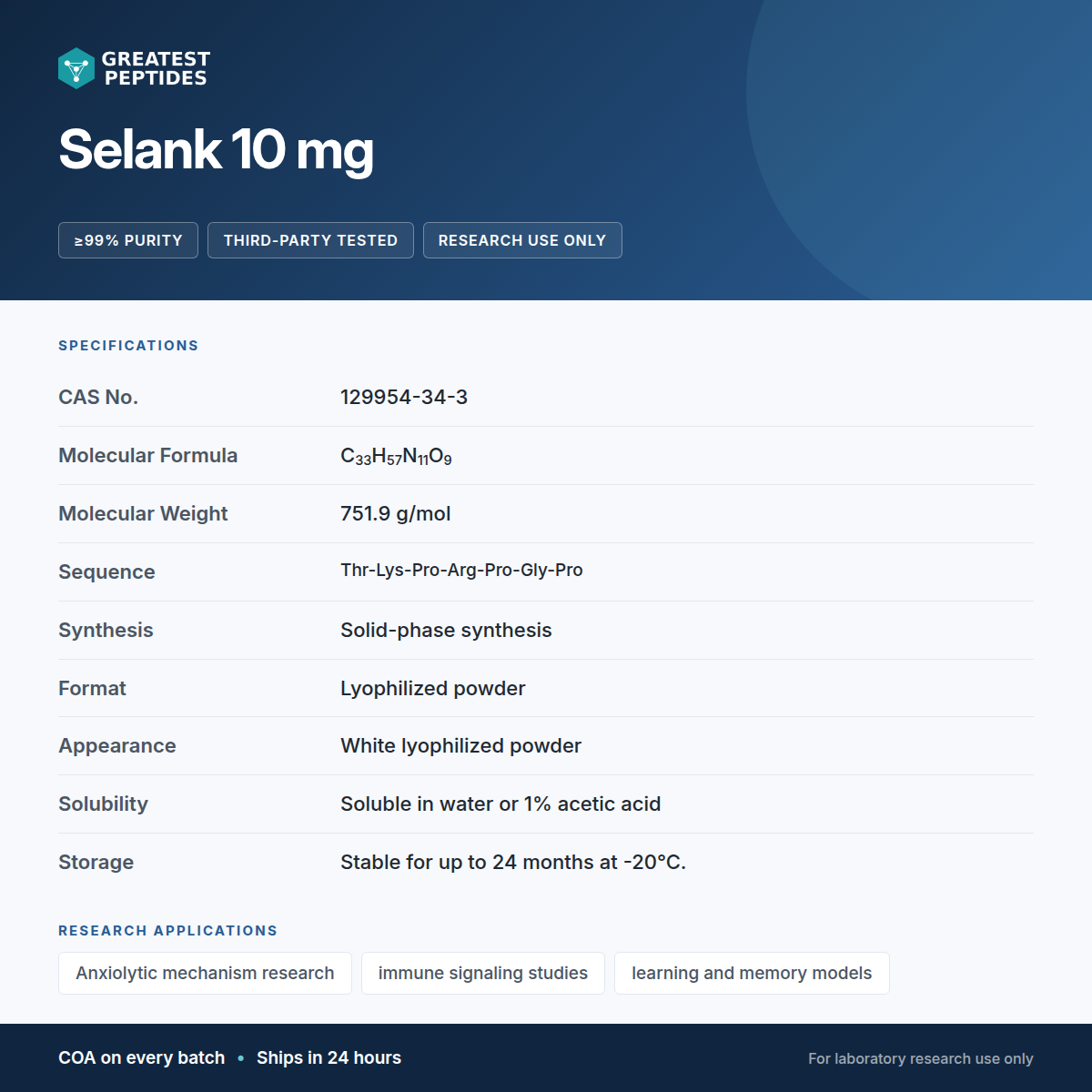
CAS No.
129954-34-3
Purity
≥99%
Sequence
Thr-Lys-Pro-Arg-Pro-Gly-Pro
Molecular Formula
C33H57N11O9
Molecular Weight
751.9 g/mol
Synthesis
Solid-phase synthesis
Format
Lyophilized powder
Solubility
Soluble in water or 1% acetic acid
Stability & Storage
Stable for up to 24 months at -20°C. After reconstitution, may be stored at 4°C for up to 4 weeks or at -20°C for up to 6 months.
Applications
Anxiolytic mechanism research, immune signaling studies, learning and memory models
Appearance
White lyophilized powder
Shipping Conditions
Shipped at ambient temperature; once received, store at -20°C
Regulatory/Compliance
Produced in a facility adhering to cGMP guidelines
Safety Information
Refer to provided MSDS
Researcher FAQ
How do I reconstitute this peptide?
Use bacteriostatic water (BAC) at a 1–2 mL volume per vial. Add the solvent slowly down the vial wall, swirl gently — never shake. Refrigerate after reconstitution and use within 30 days. For in-vitro laboratory handling only.
How should I store this product?
Lyophilized: 36–46°F (refrigerated) for up to 24 months. Reconstituted: keep refrigerated and protect from light; use within 30 days. Avoid repeated freeze-thaw cycles.
Shipping & tracking?
Orders placed before 3 PM EST ship the same business day from our USA facility. Tracking is emailed within 24 hours. Plain, discreet packaging. Free shipping on orders over $150.
Buy Selank for Research | RUO COA & Documentation Guide
For laboratory teams evaluating where to buy Selank for research, the priority is documentation, compound identity, and research-use-only (RUO) alignment. Selank is a synthetic heptapeptide (sequence Thr-Lys-Pro-Arg-Pro-Gly-Pro) derived from the immunomodulatory peptide tuftsin with an added Pro-Gly-Pro motif, catalogued by PubChem with the molecular formula C33H57N11O9 and a molecular weight of approximately 751.9 g/mol (PubChem CID 11765600)[1] (CAS 129954-34-3).
Fast Answer
Researchers evaluating where to buy Selank for research should review RUO labeling, a batch-specific certificate of analysis (COA), HPLC purity data, LC-MS or comparable identity support, sequence/mass consistency, and lot traceability before procurement. Material discussed here is intended for laboratory research use only and is not for human or veterinary use.
What Does “Buy Selank for Research” Mean?
The phrase is addressed as laboratory research-procurement intent — how qualified researchers, institutions, and technical buyers evaluate a Selank reference material through documentation, analytical support, and labeling clarity, not personal, clinical, or consumer decision-making.
Compound Identity & Classification
Compound name
Selank (heptapeptide)
PubChem CID
11765600[1]
CAS number
129954-34-3
Molecular formula
C33H57N11O9[1]
Molecular weight
≈ 751.9 g/mol[1]
Sequence
Thr-Lys-Pro-Arg-Pro-Gly-Pro
Origin
Tuftsin analog with Pro-Gly-Pro motif[2]
Product form
Lyophilized powder
Purity target
≥ 99% (see batch-specific COA)
Regulatory status
Research use only — not for human or veterinary use
Published literature discusses Selank within tuftsin-derived neuropeptide and immunomodulation research, reporting anxiolytic-model and immunoregulatory activity in cell and preclinical systems[2][3]. On a research product page this pathway context should remain academic literature interpretation used to define the research lane — it is not converted into product-performance language.
COA, Purity & Identity Documentation
A Selank COA should be reviewed as a batch-specific record, not a marketing statement. Look for compound name, lot number, test date, stated purity, analytical method, identity confirmation, and sequence/mass information. Purity, identity, method, and lot number should be evaluated together.
Evaluation area
What to review
Why it matters
RUO labeling
Clear research-use-only language
Separates research procurement from human-use positioning
COA availability
Batch-specific certificate for the received lot
Supports lot-level documentation
Purity data
HPLC area-percent support for stated purity
Helps evaluate material consistency
Identity testing
LC-MS / mass-spec confirmation vs expected mass
Confirms the material matches the listed peptide
Lot traceability
Lot number matching across records
Supports research recordkeeping
HPLC, LC-MS & Analytical Review
HPLC documentation supports purity assessment; LC-MS or mass-spectrometry documentation supports identity confirmation and molecular-mass review[10][11]. For a short heptapeptide, mass data confirming the observed mass against the expected value are especially useful alongside HPLC purity data. ICH Q2(R2) describes validation characteristics used to interpret assay, purity, and identity results[7].
Lot Traceability & Batch Documentation
Lot traceability connects the product listing, COA, label, and receiving record. ISO/IEC 17025 addresses the competence of testing laboratories, and NIST resources describe how certificates and lot identifiers support traceability[8][9].
Claim Boundary for RUO Positioning
Research-safe statement
Non-compliant version to avoid
“Selank is discussed in published literature on tuftsin-derived neuropeptide research.”
“Selank treats anxiety or stress.”
“Researchers should review COA and identity data before procurement.”
“Buy Selank for calm.”
“Greatest Peptides supplies Selank as a research-use-only material.”
“Greatest Peptides supplies Selank for treatment.”
Research Procurement Checklist
Confirm the material is labeled for research use only.
Review the batch-specific certificate of analysis for the received lot.
Confirm purity is supported by HPLC analytical data.
Confirm identity is supported by LC-MS or mass spectrometry.
Compare compound name, sequence, formula, and mass across the page, label, and COA.
Verify the lot number matches across all documentation.
Document storage and handling conditions in the laboratory record.
How Greatest Peptides Presents Selank
Greatest Peptides supplies Selank as a research-use-only laboratory material in lyophilized powder form, positioned around a stated ≥99% purity target, batch-specific COA availability, HPLC/LC-MS documentation, lot-level traceability, and transparent RUO labeling. Products are not intended for human or animal consumption, diagnostic, therapeutic, clinical, or veterinary use.
Published Literature Context
Published Selank literature spans peptide chemistry and preclinical neuropeptide and immunomodulation research models[2][3]. Model-specific findings should not be generalized or interpreted as use guidance for research-use-only materials.
Contributing Researchers
Recognized for published work that shaped the scientific context discussed above
Nikolai F. Myasoedov, PhD — led development and characterization of the tuftsin-analog heptapeptide Selank within neuropeptide research[2].
Lyudmila A. Andreeva, PhD — co-authored research on the chemistry and neuropeptide characterization of Selank[3].
FAQs About Buying Selank for Research
What should researchers check before buying Selank for research?
Review RUO labeling, the batch-specific COA, stated purity with HPLC support, LC-MS identity data, sequence/mass consistency, and lot traceability.
What is Selank in research documentation?
A synthetic heptapeptide (Thr-Lys-Pro-Arg-Pro-Gly-Pro) with molecular formula C33H57N11O9 and a molecular weight near 751.9 g/mol, derived from tuftsin.
Why does a COA matter when buying Selank?
It connects the listing to batch-specific documentation: compound name, lot number, test date, purity, and identity method for the received lot.
Is Selank intended for human or animal use?
No. Material discussed here is intended strictly for laboratory research use only.
How should published literature be interpreted?
As scientific context only. Model-specific findings should not be generalized or read as use guidance for research-use-only materials.
This page addresses Selank only as research-use-only laboratory procurement. Boundary-sensitive terms such as anxiety, stress, mood, and calm are referenced here only as research-language examples that must stay separate from RUO product positioning. All product information is for informational and educational purposes only. Products are not intended for human or animal consumption and have not been evaluated by the FDA to diagnose, treat, cure, or prevent any disease.
References
National Center for Biotechnology Information. Selank, CID 11765600. PubChem Compound record. Accessed 2026.
Myasoedov NF, et al. Selank: a tuftsin-analog heptapeptide in neuropeptide research (review). Peptide/neuroscience literature. 2010s.
Andreeva LA, et al. Chemistry and neuropeptide characterization of Selank. Peptide research literature. 2010s.
Registry record for Selank, CAS 129954-34-3. Accessed 2026.
IUPAC-IUB Joint Commission. Nomenclature and symbolism for amino acids and peptides. 1983.
U.S. FDA. Analytical procedures and methods validation for drugs and biologics. 2015.
U.S. FDA. Q2(R2) Validation of Analytical Procedures. 2024.
International Organization for Standardization. ISO/IEC 17025:2017. 2017.
National Institute of Standards and Technology. Reference materials and certificates of analysis. Accessed 2026.
Mant CT, et al. HPLC analysis and purification of peptides. Methods in Molecular Biology. 2007.
Steen H, Mann M. Peptide sequencing. Nature Reviews Molecular Cell Biology. 2004. PMID 15340378.
Compound profile
Selank: compound profile, literature landscape and handling notes
Selank in one paragraph
Selank is a synthetic heptapeptide, threonine-lysine-proline-arginine-proline-glycine-proline. The first four residues are tuftsin, a fragment of the immunoglobulin G heavy chain that was originally characterized as a stimulator of phagocytosis; the last three are a proline-glycine-proline tail added deliberately as a stabilizer. That makes Selank an unusual object in this catalog on two counts. Its backbone is an immune peptide repurposed toward central nervous system endpoints, which is a rare direction of travel, and it has no confirmed high-affinity receptor of its own, so almost every mechanism reported for it is an indirect one measured downstream. It is also a compound whose primary literature is largely in Russian, which changes how a citation on an English-language page should be read. Everything below describes the published research record and how the material behaves on a bench. Nothing here is a claim about what this vial does, and nothing here is applicable to use in humans or animals.
Where Selank came from
Selank sits at the junction of two unrelated research histories, and it is much easier to read once they are separated.
The first is tuftsin. In 1970 Najjar's group at Tufts University described a tetrapeptide, threonine-lysine-proline-arginine, that can be liberated enzymatically from the CH2 domain of the immunoglobulin G heavy chain and that stimulated phagocytic uptake by neutrophils and macrophages. The peptide carries the name of the institution. Everything about that original work is immunological: the parent molecule is an antibody, the readout was phagocytosis, and the proposed physiology was that a fragment cut out of a circulating antibody could act as a signal in its own right. Tuftsin was worked on in that frame for years, and a large share of the literature bearing the name is about macrophage and neutrophil activation rather than about anything neural.
The second history is the Russian glyproline program. From the 1980s onward the Institute of Molecular Genetics of the Russian Academy of Sciences pursued a general strategy for making short, rapidly cleared regulatory peptides survive long enough to be studied in a whole animal: extend the C-terminus with the tripeptide proline-glycine-proline, a motif borrowed from the endogenous glyprolines. The best known product of that strategy is Semax, an adrenocorticotropic hormone fragment carrying the same tail. Selank is that same strategy applied to tuftsin, so its design lineage runs through Semax and the glyproline work, not through any immunology program.
The practical consequence for a reader is worth stating bluntly. Most primary work on Selank appeared in Russian-language journals, some of which are not indexed in the databases an English-speaking researcher searches by default and few of which have full-text English versions. The English-language secondary literature has filled that gap with review articles, and those reviews are then cited by later reviews. A citation chain that looks broad frequently narrows to a small number of laboratories and a small number of original reports. Selank also has a regulatory history inside Russia with no counterpart elsewhere; that history is a fact about a jurisdiction, not evidence about the molecule, and none of it transfers to bench work.
Reading the structure of Selank
The sequence, formula and mass for this listing are printed in the specification table further down this page and are not restated here. What is worth doing instead is reading the seven residues for what each part is doing, because this is a compound where the structure is the entire design argument.
Residues one through four, threonine-lysine-proline-arginine, are tuftsin unchanged. Residues five through seven, proline-glycine-proline, are the addition. There is no substitution anywhere, no non-proteinogenic residue, no acylation, no amidation of the C-terminus in the usual commercial form, and no disulfide. Selank is therefore a plain L-amino-acid peptide, which is unusual for a designed analog and means that everything interesting about it comes from residue choice and order rather than from chemical modification.
Three of the seven residues are proline. That has consequences that go well beyond composition. Proline is a secondary amine locked into a ring, so it cannot donate a backbone hydrogen bond and it sharply restricts the phi angle of the chain. A heptapeptide with prolines at positions three, five and seven has no capacity to form a regular helix or sheet; it is a short, conformationally constrained, solvent-exposed chain. Proline also interconverts between cis and trans amide configurations slowly on the timescale of a chromatographic separation, which is an analytical fact you will meet again later on this page.
The most elegant structural detail is that both basic residues are immediately followed by proline. Trypsin cleaves after lysine and arginine but not when proline occupies the next position, so the two sites that would ordinarily make this peptide a trypsin substrate are blocked by the residue that follows them. The same proline placement narrows the set of other endopeptidases that can act on the chain interior.
The proline-glycine-proline tail is where the design intent lives. It is not there for activity; it is there because exopeptidases that trim from the C-terminus handle a proline-rich terminus poorly, so the tail acts as a sacrificial and slow-to-remove cap. It is important to be precise about what that buys. The extension protects the carboxy end. It does not protect the amino end, where threonine-lysine remains an ordinary aminopeptidase substrate, and it does not confer resistance to prolyl-specific peptidases, which are the enzymes most suited to a sequence like this one. The stabilization is real and it is asymmetric.
The target and the pathway in more detail
The honest starting point is that Selank has no confirmed high-affinity receptor. There is no cloned target, no accepted radioligand binding curve for the intact heptapeptide, and no antagonist that reverses its reported effects in a way that would establish receptor mediation. Secondary sources routinely describe it as a modulator of one system or another, and it is worth noticing that the word modulator is doing the work an identified target would otherwise do.
What the tuftsin half brings is a partial exception. Tuftsin itself has a longer target literature than Selank does, including reports of binding to receptors on phagocytes and later work identifying neuropilin-1 as a binding partner in macrophage and microglial systems. Whether the intact heptapeptide retains that interaction is a separate empirical question, and the C-terminal extension sits exactly where a receptor engaging the tuftsin C-terminus would be affected. Treating tuftsin target data as Selank target data is one of the most common errors made about this compound.
The mechanisms actually reported for Selank are downstream and indirect. Several are enzymatic rather than receptor-based. The most mechanistically interesting is the reported inhibition of enkephalin degradation in blood: rather than binding an opioid receptor, the peptide is described as slowing the enzymes that clear leucine-enkephalin, which would prolong the lifetime of an endogenous ligand rather than substituting for it. That is a genuinely different class of claim from receptor agonism, and it is testable in a cell-free system, which is a point in its favor.
The other reported mechanisms are expression-level. Published work describes changes in the expression of gamma-aminobutyric acid type A receptor subunits in rodent brain regions, changes in brain-derived neurotrophic factor expression, effects on monoamine turnover, and changes in the expression of cytokine and interferon-related genes. That last category is the one most consistent with the tuftsin heritage and is often overlooked by sources that present Selank purely as a nervous-system compound.
Expression-level readouts are informative but they are several steps removed from a target. A change in subunit messenger RNA hours after exposure is compatible with direct receptor engagement, with an indirect signaling cascade, with a stress response, and with a systemic effect fed back into the brain. Distinguishing those requires binding data that does not currently exist in a form a careful reader can rely on.
What the published literature on Selank actually measures
The published record on Selank divides into five recognizable groups, and identifying which one a given citation belongs to tells you most of what you need to know about how much weight it carries.
The largest by volume is rodent behavioral pharmacology from Russian laboratories. These are conflict paradigms, elevated plus maze and open field work, and comparisons against benzodiazepine reference compounds run in the same experiments. What these papers measure are behavioral endpoints in animals under defined conditions. Many predate the current conventions on reporting randomization, blinding and sample-size justification, and a substantial fraction were published in journals whose peer review process is not documented in English. They are evidence, but they are evidence of a kind that requires the reader to know its provenance.
The second group is gene-expression work from the originating institute, and it is the part of the record most accessible in English. Microarray and quantitative polymerase chain reaction studies in rat hippocampus, other brain regions and peripheral blood cells report expression changes across immune, neurotransmitter and neurotrophic gene sets. These papers are useful precisely because their readouts are concrete and the methods are reproducible in principle by anyone with the same platform.
The third is peptide chemistry and stability: comparisons of how quickly Selank and tuftsin disappear in plasma or blood, identification of the fragments generated, and characterization of which enzymes are responsible. This is the literature that supports the design rationale for the tail, and it is the literature a bench researcher planning an incubation should read first.
The fourth is the enzymology around enkephalin-degrading activity, a small but focused set of reports that describe an effect measurable outside a cell.
The fifth is clinical reporting in Russian psychiatric and neurological journals. Whatever its merits in its own context, it is of no use as a bench reference. It does not characterize the molecule, and it should not appear in the methods section of an in vitro protocol.
A sixth category deserves naming because it is so often mistaken for the literature itself: the English-language narrative review that summarizes the Russian work without reproducing its data. Those reviews are where most online descriptions of Selank actually come from.
Where the Selank literature is thin or frequently misread
The Selank literature has a specific and unusual weakness, which is not that it is small but that it is hard to audit.
The language barrier is the first and most consequential issue. A researcher who wants to check a claim about Selank frequently cannot reach the original report, and the intermediate source is a review that paraphrases it. Paraphrase loses the experimental conditions, and experimental conditions are exactly what determines whether two reports agree. This is not an argument that the underlying work is wrong. It is an argument that a claim about Selank should be cited to whatever the reader has actually read, and that a review should be cited as a review rather than dressed up as primary data.
The second is concentration of authorship. A large share of the mechanistic work traces back to one institute and its immediate collaborators. Single-group findings are not invalid, but they have not been subjected to the independent replication that would let a reader treat them as settled, and the review literature does not usually flag this.
The third is the missing target. Because there is no receptor to anchor the pharmacology, effects reported at the expression level cannot be ordered into a causal chain, and the resulting descriptions tend toward lists of systems the compound is said to influence. A list of affected systems is a weaker claim than it looks.
The fourth is the tuftsin transfer error already mentioned: immunological data generated on the tetrapeptide is regularly presented as though it characterized the heptapeptide.
The fifth concerns the fragments. It is often implied that the tail simply makes the molecule last longer and that whatever is cleaved off is inert. Proline-glycine-proline and its N-acetylated form have their own reported activity in the neutrophil chemotaxis literature, and other glyprolines have been studied as active peptides in their own right. A degradation product with reported activity is a confound, not a footnote, and any experiment long enough for meaningful cleavage should account for it.
The sixth is over-reading of stability. The tail slows exopeptidase trimming from one end. It is frequently described as though it made the peptide robust in general, which it does not.
How Selank behaves in solution
Selank is at the opposite end of the solubility spectrum from the acylated peptides elsewhere in this catalog, and most of its handling behavior follows from that.
It is a small, strongly hydrophilic peptide with two basic side chains and a free alpha-amino group, so it carries a net positive charge across the ordinary working range of pH and dissolves in water readily and completely. There is no lipophilic chain, no self-association driven by a hydrophobic tail and no tendency to form the higher-order assemblies that complicate work with amphiphilic analogs. Lyophilized material of this kind is typically hygroscopic, and a cake that has taken up atmospheric moisture will often look slightly collapsed or glassy before anything is wrong with the peptide itself.
Adsorption still occurs, but the mechanism is electrostatic rather than hydrophobic. A cationic peptide binds to the negatively charged silanol surface of untreated glass and to some plastics, and the loss is worst at low concentration and high surface-to-volume ratio, which is exactly where a working dilution lives. Low-binding labware, a modest concentration of a competing salt or a carrier protein, and fewer transfer steps all reduce it, and any of those choices belongs in the record because they change the matrix.
The chemical degradation picture is unusually favorable and worth appreciating. There is no methionine, no cysteine and no tryptophan, so oxidation is not a dominant route. There is no asparagine or glutamine, so the deamidation chemistry that dominates the stability of many peptides is simply unavailable here. What remains is hydrolysis of the backbone and one specific route worth knowing: a sequence with proline in the third position is prone to intramolecular attack that releases the N-terminal two residues as a diketopiperazine, and Selank has proline in exactly that position.
Microbial growth in an unpreserved aqueous solution is a more realistic threat to this material than chemical breakdown over short storage. And the trap specific to Selank is that a degraded solution usually still looks perfectly clear. An aggregating peptide announces its failure visually; this one does not, so appearance is close to worthless as an integrity check. The storage statement in the specification table on this page is the product record for the material, and the documentation supplied with the lot is what governs.
Analytical notes specific to Selank
Selank presents two analytical problems at once: it is invisible where peptides are usually detected, and it does not stay on the column.
The detection problem comes first. There is no tryptophan, tyrosine, phenylalanine, histidine or cystine anywhere in the sequence, so the peptide has no aromatic chromophore at all and no usable absorbance near 280 nanometers. Detection has to sit at low ultraviolet, around 214 nanometers, where the signal comes from the peptide bond itself. Two things follow. Response there scales roughly with the number of amide bonds, so a short impurity gives a peak far smaller than its molar share, and an area-percent figure from a single low-ultraviolet wavelength is a biased estimate rather than a composition. Low ultraviolet also responds to plenty of non-peptide species, including residual solvent and some buffer components.
The retention problem compounds it. A seven-residue peptide with two basic residues and no hydrophobic face has almost nothing to hold onto a C18 stationary phase, so without ion-pairing it elutes at or near the void volume. That is precisely where salts, free amino acids, short truncation and deletion sequences and small process residues also elute. Trifluoroacetic acid as an ion-pairing additive improves retention and peak shape substantially, and a mixed-mode or hydrophilic-interaction separation is a genuinely orthogonal second method rather than a variation on the first. If a purity figure for a peptide this polar comes from one reversed-phase run, the near-void population is what it is least able to see.
The three prolines add a third effect. Cis-trans isomerization on the separation timescale broadens peaks and can split them into partially resolved pairs. A raised, tightly controlled column temperature usually coalesces them. A split peak here is a conformational artifact more often than a second species, and it is misread as an impurity often enough to be worth stating.
Mass spectrometry is comparatively kind here. At seven residues, losing a single amino acid is a large fractional change in mass and stands out clearly, unlike a forty-residue peptide where a small deletion hides inside the isotope envelope. Tandem mass spectrometry producing a sequence ladder is what distinguishes Selank from a rearranged or truncated peptide of identical composition, because intact mass cannot order residues. One method note: amino acid analysis using ortho-phthalaldehyde derivatization does not react with secondary amines and misses proline, and this molecule is three-sevenths proline, so the derivatization chemistry matters here.
The nearest neighbor and the most frequent mix-up. Semax is an adrenocorticotropic hormone fragment carrying the same C-terminal proline-glycine-proline tail; Selank is tuftsin carrying that tail. They share a stabilizing motif and a country of origin and nothing else. Different parent peptide, different residue composition, different reported mechanisms, separate literatures. Sharing a tripeptide cap is not a pharmacological relationship.
Another short peptide with a thin target definition, but the resemblance stops at that. DSIP is a longer, acidic nonapeptide from a Swiss research line with no tuftsin content and no glyproline tail. It is grouped with Selank in secondary sources mainly because both are short central nervous system peptides whose receptors were never established, which is a shared absence of evidence rather than a shared mechanism.
Tuftsin
The unmodified tetrapeptide that forms the first four residues. Its literature is immunological, centered on phagocytosis and macrophage activation, and it is cleared far more quickly than the extended peptide. Data generated on tuftsin does not characterize Selank, and the C-terminal extension sits exactly where a receptor recognizing the tuftsin C-terminus would notice the difference.
Noopept
Frequently listed alongside Selank because both come out of Russian research and both are marketed into the same category. Noopept is not a peptide product in the sense used here; it is a synthesized small molecule built on a proline-glycine dipeptide framework as an ester, with its own reported metabolite chemistry. Different material class, different handling, different analysis, unrelated mechanism.
Pro-Gly-Pro and N-acetyl-Pro-Gly-Pro
The free glyprolines, which matter here because they are the tail rather than a relative. They have their own published literature, including reported activity in neutrophil chemotaxis for the acetylated form. That makes them plausible active degradation products of Selank rather than inert leftovers, and it is a control worth including in any long incubation.
Questions specific to Selank
Is Selank just tuftsin with an extra tail, and does tuftsin research apply to it?
Structurally the first half of that is accurate: residues one to four are tuftsin unchanged, and residues five to seven are the added proline-glycine-proline. The second half does not follow. Tuftsin's published record is immunological, built around phagocytosis and macrophage readouts, and it was generated on a tetrapeptide that is cleared much faster than the extended form. Adding three residues changes the C-terminus, which is the end most likely to matter for whatever recognizes tuftsin, and it changes the clearance profile enough that the exposure conditions in a tuftsin experiment are not reproduced. Treating tuftsin binding or activity data as though it characterized Selank is the single most common error in secondary descriptions of this compound. In practice, if a claim about Selank cites a tuftsin paper, it is a claim about tuftsin.
What does the proline-glycine-proline extension actually protect against?
It is a C-terminal cap aimed at exopeptidases. Carboxypeptidases handle a proline-rich terminus poorly, so the tail slows trimming inward from that end, and the published stability comparisons between the extended peptide and tuftsin are the evidence for the design. Being precise about the limits matters. The amino terminus is untouched: threonine-lysine is a normal aminopeptidase substrate and the tail does nothing for it, so the protection is one-sided. Prolyl-specific peptidases are, if anything, better suited to a sequence like this than to an average peptide. And nothing about the tail affects chemical stability in solution, adsorption to surfaces, or susceptibility to conditions in a buffer. It buys time against one specific class of enzyme, which is worth having and is narrower than the phrase stabilized peptide suggests.
Why is Selank not interchangeable with Semax in an experiment?
Because the only thing they share is the last three residues. Semax is derived from a short fragment of adrenocorticotropic hormone; Selank is derived from an immunoglobulin fragment. The parent peptides come from different proteins, serve different physiology, and have separate literatures with different reported mechanisms. The shared proline-glycine-proline tail is a stabilizing device that the same research program attached to both, which is a fact about the chemists rather than about the pharmacology. They also differ analytically: Semax contains aromatic and imidazole residues that Selank lacks entirely, so their ultraviolet behavior and their reversed-phase retention are not comparable either. Using one as a control or a surrogate for the other is not supportable from anything in the published record.
What would count as real evidence for a Selank receptor?
The conventional set, none of which currently exists in a form a careful reader can lean on. Saturable, specific and reversible binding of a labeled form of the intact heptapeptide to a defined preparation, with a displacement curve and a stated affinity. A functional readout in a cell line expressing a candidate target and absent in the parental line. Loss of effect when the candidate is deleted or knocked down. Reversal by a selective antagonist at concentrations consistent with the binding data. Until something in that list is published, the reported gene-expression and neurotransmitter effects are best described as downstream observations of unknown proximate cause. That is not a criticism of the observations; it is a statement about what they can and cannot support. The enzymatic claim around enkephalin degradation is the most directly testable part of the mechanism story, because it can be examined in a cell-free system without needing a receptor at all.
How should I handle the fact that most of the primary literature is in Russian?
Cite what you have actually read. If the accessible source is an English review, cite it as a review and describe the finding as reported rather than as established. If a specific claim is load-bearing for your work, get the original translated rather than relying on a paraphrase, because the experimental conditions are what determine whether two reports are consistent and paraphrase is where those conditions get lost. It is also worth mapping the authorship: a striking amount of the mechanistic record traces to one institute and its collaborators, so several citations that look independent may not be. None of this means the underlying work is unsound. It means the usual signal that a finding has been replicated, namely several unconnected groups reporting it, is weak here and should not be assumed from the number of references in a review.
Why does area percent at low ultraviolet understate short impurities in Selank?
Two reasons that compound each other. First, the peptide is extremely polar and has no hydrophobic face, so on a C18 phase it elutes close to the void volume, which is the same place salts, free amino acids and short truncation products elute. Anything hiding there is unresolved from the main peak by definition. Second, with no aromatic residue anywhere in the sequence there is no absorbance near 280 nanometers, so detection is at around 214 nanometers, where response tracks the number of peptide bonds. A three-residue fragment therefore contributes a much smaller area than its molar share, and a purity figure computed as area percent understates short impurities systematically. An orthogonal separation, such as a hydrophilic-interaction or mixed-mode method, adds far more information here than a second reversed-phase run with a different gradient.
Are the fragments generated as Selank breaks down inert?
There is no basis for assuming so, and some reason to assume the opposite. The tail is proline-glycine-proline, a glyproline; free proline-glycine-proline and particularly its N-acetylated form have their own published literature, including reported activity as a neutrophil chemoattractant. The other predictable fragment is tuftsin or a truncated version of it, which has an entire immunological literature of its own. So the degradation products of this heptapeptide are not obviously silent molecules, and in a long incubation, in serum, or in any system containing active peptidases, the species present at the end of the experiment may not be the species added at the start. If a readout develops over hours, including the fragments as separate comparison arms is a reasonable design precaution rather than an exotic one.
Documentation and handling reference
Selank: Documentation, Handling and Quality Record for This SKU
The section above covers what Selank is and what the published literature has looked at. This section is the operational half: what physically arrives when you order this listing, what paperwork comes with it, which fields on that paperwork are worth reading closely, and how to log the material once it is on your bench. It is written for the person who has already decided the compound is relevant and now has to justify the purchase to a supervisor, a grant line or an internal quality process.
Everything below is scoped to this exact listing rather than to research peptides in general. If you want the general version — how to read a certificate of analysis from scratch, what HPLC and mass spectrometry each prove, how to compare two suppliers who both claim 99% — that is on the home page guide, and there is no reason to read it twice.
What ships when you order Selank
At a glance
One sealed vial of lyophilized material at the listed 10 mg fill, labeled for research use only, dispatched within 24 hours of the order clearing. Batch documentation is available for the lot you receive. Free shipping applies at $150 and above.
This listing is a single fixed presentation, not a size selector. That is deliberate: each presentation gets its own page, its own documentation trail and its own URL, so a citation or a purchase-order line that points at Selank at 10 mg points at exactly one thing. If you need a different fill of the same compound and it is not listed, it is not currently in stock rather than hidden behind a dropdown.
Field
This listing
Listing
Selank 10 mg
Labeled fill mass
10 mg
Physical form
Lyophilized powder in a sealed vial
Catalog category
Neuropeptide & CNS-Active Compounds
Compound class
Neuroactive research peptide
Intended use
Research use only. Not for human or veterinary use, not for diagnostic use, not a drug or supplement.
Dispatch
Within 24 hours of the order clearing
Documentation
Batch analytical documentation available for the lot supplied
Free shipping threshold
Orders of $150 and above
Specification summary for Selank
The table below is the specification the store publishes for this listing. It is reproduced here from the product record itself rather than retyped, which means it cannot drift away from what the attribute table further up the page says. Where a field is absent it is absent because we do not publish it for this SKU, not because it was left out of this summary.
CAS No.
129954-34-3
Purity
≥99%
Sequence
Thr-Lys-Pro-Arg-Pro-Gly-Pro
Molecular Formula
C33H57N11O9
Molecular Weight
751.9 g/mol
Synthesis
Solid-phase synthesis
Format
Lyophilized powder
Solubility
Soluble in water or 1% acetic acid
Stability & Storage
Stable for up to 24 months at -20°C. After reconstitution, may be stored at 4°C for up to 4 weeks or at -20°C for up to 6 months.
Applications
Anxiolytic mechanism research, immune signaling studies, learning and memory models
Appearance
White lyophilized powder
Shipping Conditions
Shipped at ambient temperature; once received, store at -20°C
Regulatory/Compliance
Produced in a facility adhering to cGMP guidelines
Safety Information
Refer to provided MSDS
A specification table is a claim, and a claim is only worth the record behind it. Every field above is one you can ask us to substantiate against the batch documentation for the lot you were sent. If a field ever fails to match the paperwork, that is a defect on our side and we would rather hear about it than not.
Several materials in this group are close structural relatives of one another, and a couple differ by a single residue. Sequence-level confirmation is the only thing that separates them; a purity percentage does not.
The analytical record behind this lot
A certificate of analysis is not a quality badge. It is a measurement report about one specific batch, produced on a specific date by a specific method, and its value to you is entirely a function of how much of that context it discloses. For Selank the fields worth checking first are the ones that tie the document to the container in your hand.
Field on the certificate
Why it matters for this SKU
Lot or batch identifier
Ties the document to the vial. A certificate with no lot reference describes some batch, not necessarily yours.
Compound name and, where applicable, sequence
This is the identity claim. For a neuroactive research peptide it is the field that distinguishes the material from its close relatives.
Analytical method and conditions
A purity figure without a method is a number without units. Column, gradient and detection wavelength change what the figure means.
Date of analysis
Establishes how old the measurement is relative to the material. A recent vial with a two-year-old certificate is a documentation gap.
Who performed the analysis
In-house and independent third-party results are both legitimate; they are not the same claim, and the document should say which it is.
The chromatogram or spectrum itself
A summary table can be typed by anyone. A trace can be read, and a reader who knows the compound class can tell whether it is plausible.
What our documentation for Selank does assert is what the analysis measured on the batch that was tested. What it does not assert — and no certificate from any supplier can assert — is that the material is safe, that it is suitable for any use in humans or animals, or that it will reproduce a result reported in a published paper. Those are different questions and a purity figure is not evidence for any of them.
Our batch documentation policy, including how to request the record for a lot you already have, is on the certificate of analysis page. If you need the record before ordering rather than after, ask us through the contact page and reference this listing by name.
How Selank is checked before it reaches this catalog
Three questions have to be answered separately before a compound gets a page here, and collapsing them into one percentage is the most common way a supplier listing becomes misleading.
Question
What answers it
What it does not tell you
Identity — is this the right molecule?
Mass determination, and sequence confirmation where the material is a defined chain
Nothing about how much of the vial is that molecule
Purity — what proportion of the detected material is the target?
Chromatographic separation with a stated method
Nothing about what the other fraction actually is, unless the impurities are themselves identified
Content — how much target material is actually in the container?
Quantitative determination against the labeled fill
Nothing about identity or purity; a vial can be accurately filled with the wrong thing
For Selank, receptor binding panels, neurotrophic factor expression assays and behavioral batteries are the assay formats the published work in this area tends to use, which matters when you are deciding whether the material as supplied is fit for the experiment you have in mind. A compound that is clean enough for a binding assay is not automatically clean enough for a quantitative cell-based readout where a co-eluting impurity could carry activity of its own.
Content is the field most often missing from a supplier listing, and it is the one that changes your arithmetic. A vial labeled 10 mg contains that much total solid, and total solid includes counter-ion, residual water and whatever else survived the process. If you need the peptide mass rather than the vial mass to be exact, that is a specific request to make in advance, not an assumption to carry into a calculation.
Receiving, inspecting and storing Selank
The most useful five minutes you will spend on this material are the five minutes immediately after the package is opened, because that is the only moment at which you can still distinguish a transit problem from a handling problem of your own.
Confirm the label on the container matches this listing, including the fill mass, and record the lot identifier in your notebook before anything else happens.
Inspect the closure and seal. A compromised closure is a reason to stop, not a reason to proceed carefully.
Look at the cake. Note its appearance and position; a cake that has collapsed, shifted or gone glassy is telling you something about the vial's history in transit.
Let a cold vial reach room temperature before opening it, so that atmospheric moisture condenses outside the vial rather than into the material.
Photograph the label and the container on arrival. It costs nothing and it settles later questions instantly.
Store it in the dark, at the temperature stated for this listing, and write down the date it entered storage.
Decide your aliquot plan before the first opening, not after it.
Small neuroactive sequences are often supplied at low fill masses, which makes weighing error a proportionally larger problem than it is for a 70 mg vial.
The general rule for lyophilized material is that the dry state is the stable state and every transition away from it costs you something. Freeze-thaw cycling is the specific mechanism most likely to degrade Selank after it reaches you, and it is entirely under your control: a single reconstitution split into pre-planned aliquots exposes the material once, while repeatedly warming and refreezing one container exposes it as many times as you open it. There is a fuller treatment of the mechanism in our guide on freeze-thaw cycles in peptide research materials and on storage and handling.
Preparing aliquots from a 10 mg vial: the measurement arithmetic
This is arithmetic, not guidance. The only thing the table below does is tell you what concentration you are holding after you have added a known volume of diluent to a vial labeled 10 mg, so that the figure in your notebook and the figure in the container are the same figure. It says nothing about how much material any experiment should use, and it is not applicable to any use in humans or animals.
Diluent added
Resulting concentration
Amount in 0.1 mL
Amount in 0.05 mL
Aliquots of 0.25 mL
1 mL
10 mg/mL
1,000 µg
500 µg
4
2 mL
5 mg/mL
500 µg
250 µg
8
3 mL
3.33 mg/mL
333.3 µg
166.7 µg
12
5 mL
2 mg/mL
200 µg
100 µg
20
Every figure above is the same division: the labeled mass of Selank divided by the volume of diluent added. Nothing in the table is a recommendation about how much material to use in an experiment — it is the arithmetic that tells you what concentration you are holding once you have added a known volume, so that the number you write in the notebook matches what is in the container.
Two things routinely go wrong at this step. The first is treating the labeled mass as the peptide mass; as noted above, the labeled figure is total solid unless the documentation says otherwise, so a concentration derived from it is a nominal concentration. Say so in your methods rather than implying a precision the specification does not support. The second is ignoring the volume the solid itself occupies — small at these masses, but not zero, and it means the final volume is very slightly greater than the volume you added.
If you want to work backwards from a target concentration to a diluent volume, or to check a figure against a different vial size, our peptide reconstitution calculator does the same division in both directions and shows its working.
What to record for Selank so the work is reproducible
Reproducibility in this area fails at the material-provenance step far more often than at the analysis step. The fields below are the ones that let somebody else — a reviewer, a collaborator, or you in eighteen months — work out whether two sets of results were generated with comparable material.
Supplier and the exact listing name, including the fill size, rather than just the compound name
Lot identifier, and the date the batch documentation was issued
Date received, and the storage conditions and location it went into
Date of reconstitution, the diluent used and its lot, and the volume actually added
Nominal concentration obtained, stated as nominal rather than as measured
Aliquot scheme: how many, what volume, stored where
Freeze-thaw count for each aliquot at the point of use
Any deviation from plan, including deviations that seemed unimportant at the time
Whether the material was research-use-only labeled, which for this listing it is
Comparing suppliers on this exact SKU
Comparing Selank across suppliers on price alone is comparing two numbers that may not describe the same thing. These are the questions that make the comparison meaningful, with our answers next to them so you can hold us to the same standard you would hold anyone else.
Question to ask any supplier
Our answer for this listing
Is batch documentation available for the specific lot I will receive, not a representative lot?
Is there a published position on what the documentation does not prove?
Yes. It is stated on this page and on every product page.
A supplier who answers all seven honestly is a better bet than a supplier who is ten percent cheaper and answers four. A supplier who cannot answer the first one at all is not selling you documented material; they are selling you a container.
Compliance boundary for Selank
Selank is supplied for laboratory research use only. It is not a drug, not a supplement, not a cosmetic and not a medical device. It is not for human or veterinary administration, not for diagnostic use, and not for use in food. That is not a disclaimer bolted onto a sales page — it is the actual scope of what is being sold, and it constrains what can honestly be written about it.
Language that stays inside the boundary
Language that does not
"Supplied for research use only"
Any phrasing that implies a personal or clinical use
"Published work in this area has examined receptor and transporter interaction, neurotrophic marker expression and behavioral endpoints in animal models"
"Selank does X" stated as an established effect
"Purity determined by the stated method on the tested batch"
"Pharmaceutical grade", "medical grade", "safe"
"Concentration arithmetic for preparing laboratory aliquots"
Anything framed as a dose, a protocol or a schedule
"Not for human or veterinary use"
Silence on the point, which readers correctly interpret as evasion
Naming the model system a finding came from
Reporting an animal or in-vitro finding as though it were a human finding
The reason to be precise about this is not only regulatory. Research literature on this class of material is genuinely interesting and genuinely incomplete, and overstating it makes the real findings harder to see. Where published work is referenced on this site it is referenced as what was measured, in what system, at what scale — not as a property of the vial.
Other Neuropeptide & CNS-Active Compounds listings
These share a catalog category with Selank, which means the documentation and handling considerations above largely transfer to them. Their compound-specific sections do not — each has its own identity, its own literature and its own analytical profile.
$50.99Original price was: $50.99.$44.99Current price is: $44.99.
The full catalog is on the shop page, and the longer written material is in our research guides.
Questions about ordering Selank
Is Selank documentation available before I order?
Yes. Ask through the contact page and reference this listing by name. Our general position on batch documentation is on the certificate of analysis page. If a supplier will not show you the record until after payment has cleared, that is worth noticing.
What does the 10 mg figure on the label actually refer to?
It is the labeled fill for this presentation. For lyophilized material the labeled mass is total solid unless the documentation states otherwise, and total solid includes counter-ion and residual moisture as well as target compound. If your calculation depends on the distinction, resolve it against the batch record rather than assuming.
How fast does Selank ship?
Within 24 hours of the order clearing. Orders of $150 and above ship free. Transit time after dispatch depends on the service selected at checkout.
Can I buy Selank for personal use?
No. This material is supplied for laboratory research use only. It is not a drug, supplement or cosmetic, it is not for human or veterinary administration, and nothing on this page should be read as guidance for any such use.
How should Selank be stored before and after reconstitution?
Store the sealed vial dry, dark and at the temperature stated for this listing, and record the date it entered storage. Once material is in solution the useful discipline is to minimize repeated warming: plan the aliquot scheme before the first reconstitution so the material is exposed once rather than once per experiment. Small neuroactive sequences are often supplied at low fill masses, which makes weighing error a proportionally larger problem than it is for a 70 mg vial.
How much diluent should I add to a 10 mg vial?
That depends entirely on the concentration your protocol calls for, which is your decision and not something a product page can answer. What the table above provides is the arithmetic: labeled mass divided by added volume gives concentration. The reconstitution calculator runs the same division in either direction.
Does a high purity figure mean Selank is safe?
No, and this is the single most common misreading of a certificate of analysis. Purity describes what proportion of the detected material was the target compound in the batch that was tested, by the method stated. It is not a safety assessment, it says nothing about suitability for any use in humans or animals, and it does not become a safety claim by being a large number.
What is Selank classified as in your catalog?
It is listed as a short neuroactive sequence, in the Neuropeptide & CNS-Active Compounds category. Published work in this area has looked at receptor and transporter interaction, neurotrophic marker expression and behavioral endpoints in animal models. That is a description of where the literature sits, not a claim about what the material does.
Do you have more general written material on evaluating research peptides?
Yes. The home page guide covers reading a certificate of analysis, what chromatographic and mass-spectrometric methods each prove, and how to compare suppliers. The research guides go deeper on individual topics, and the FAQ covers ordering, shipping and post-shipping questions.
Selank 10 mg is supplied strictly for laboratory research use. It is not a drug, supplement, cosmetic or medical device; it is not for human or veterinary use, not for diagnostic use and not for use in food. No statement on this page is intended to describe a therapeutic use, benefit or outcome, and references to published work describe what was measured in the reported model system rather than a property of the material supplied. Purchasers are responsible for handling the material in accordance with the requirements applicable to their institution and jurisdiction.
Check the documentation before you check the price